

Texas Global Services Speaks at Texas A&M Mays Business School
Texas Global Services Speaks to Supply Chain Students on AI and Nearshoring
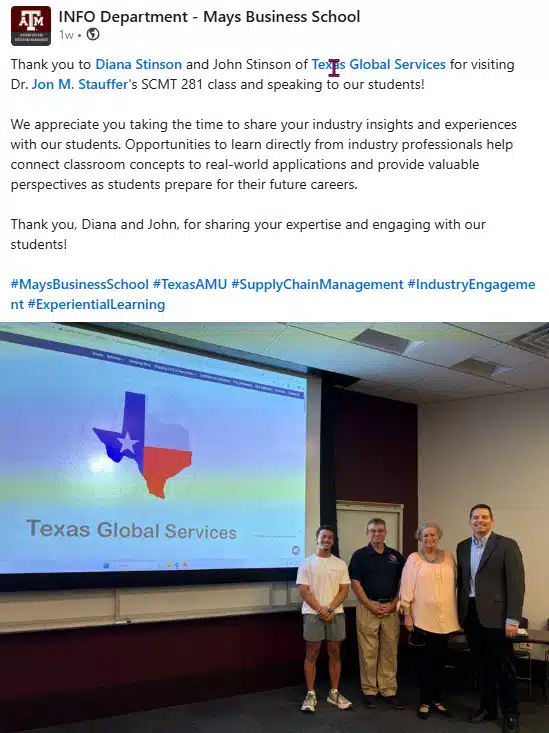
On November 6th, 2026, Texas Global Services founder and President Diana Stinson and John Stinson were the speakers for roughly 100 logistics students in the SCMT 281 Course at Texas A&M University’s Mays Business School. The visit came at the invitation of Dr. Jon M. Stauffer, Mays Professorship in Business Administration and Director of the Supply Chain Consortium at Texas A&M.
As President of a Houston freight forwarder moving cargo through the Port of Houston for more than 22 years, Diana focused on how Nearshoring affects your Supply Chain and options.
John Stinson has been the back office IT/Bookkeeper at family businesses over 25 years. He spoke about how AI has affected Texas Global Services and renewed his effectiveness and relevance.
AI in Freight Forwarding
“The software is now free and the bottleneck is you” -John Stinson (read speech here)
Nearshoring and U.S.–Mexico Trade
“Nearshoring is about options and it delivers. It is not if you can afford to do it. The question is can you afford not to do it?” -Diana Stinson (read speech here)
Thank You, Texas A&M
Thank you to Dr. Jon M. Stauffer and the Mays Business School for having us, and to the SCMT 281 students for their sharp questions and networking. These students are the next generation of supply chain leaders, and it was a privilege to share our experience.
Mays Business School Linked-In Post
About Texas Global Services
Texas Global Services is a woman-owned, FMC-licensed freight forwarder based in Houston, Texas. Founded by Diana Stinson in 2016, we arrange air freight, ocean freight, project cargo, and customs services for manufacturers, oilfield companies, importers, and exporters across the Gulf Coast and worldwide. Request a quote for a shipment of any size.
John Stinson’s talk on AI in Freight Forwarding
Good morning.
I’m truly delighted to have an opportunity to speak today.
I am John Stinson, co-owner of Texas Global Services. I am responsible for the bookkeeping, website and SEO. Yes, I was a computer technician in 1990, five years before there was an internet. I know, it’s shocking. If you’re wondering what computer technicians did before there was internet, that’s a good question.
We installed network printers and got users setup to print and access the domain and the applications. Apps were appetizers at this point. We got coffee, walked around acting cool because we were IT guys. That was pretty much the job. You had to wear a tie then.
I worked at family small businesses in my twenties and was always the bookkeeper/IT guy. The next function in small business is sales support. Does not matter what you do, supporting the sales department might not be your primary function but is the most important function you serve in a small business. Being family, I had a vested interest early on.
After 10 years, I moved to corporate life as desktop support or on call technician. 2009, I went back to being a reseller with a huge opportunity. Hardware sales and installation for conference rooms at a Fortune 50 company on their approved vendor list. This was making me lots of money. I finally lost the account after 7 years and the computer industry had passed me by as a result. Sadly, the end of my IT career was upon me. The only job I could get was installing hardware with no sales commission. I was not very pleased. My knowledge was outdated and for the first time, I was not in demand at 46 years old. I was performing skilled labor for an hourly rate. Not the business owner that I had foreseen and trained for.
My wife was a freight forwarder and working for someone else making them a lot of money. I told her I could create a company for her, get her a license and do her accounting if she liked and she could make 3x the money. She laughed but finally accepted. Knowing she could make it in her industry with her years of experience and contacts, I gave her my all. I made the website, obtained the license, installed and setup the software and equipment. I got her shipping live before the end of 2016 in just 5 months. At least, she was impressed with my outdated IT work. I had no idea in 6 years she would come back to offer me a job. I was thrilled as I was getting too old to do installs. She had hired a new forwarder that was a heavy hitter and Diana was an industry veteran with technology and accounting demands herself. I was struggling to keep up with bookkeeping and the SEO/Website were moving past my skillset. The sales were increasing and we were doing great. Even though performing at my highest level in years, it wasn’t good enough. Nowhere near good enough. There were companies with better SEO and websites, not to mention my bookkeeping and reporting were soft.
While trying to get more backlinks rankings boost for the website, Google hit me hard with 2 core updates on EEAT and toxic backlinks 2024. I had two forwarders with lots of business and commissions and a bookkeeping pile. Then there was no pile of bookkeeping and two forwarders asking where all the quotes went. New customers are mandatory no matter how well your sales are doing. This was a serious problem and over my head. The small problems of success were nothing compared to this.
I went to the AI, LLM’s (large language model). I consulted the AI about my website issues. The prognosis was bad. Told me we could fix it no problem in one year. One year? Yikes! So I kept talking and actually achieved some goals with AI. I fixed the content after learning what google actually wanted, fixed the linking structure, added blogs, removed toxic links and the website got better and better. Better than had ever been in 10 years. After only 6 months, I had forwarders happy with me and telling me about their quote requests. This was the technology gap I had trouble with for recent years. I was extremely inspired by this. I was relevant and effective again. I wanted more.
I asked what it could do for my freight business and the answer was anything. Recommended an in house SLM (small language model) convinced me I could do it. So I spent under $1000 on a refurbished Dell workstation and rtx 3060. I was armed with used product and ambition. I spent under $1,000 on an 8 billion parameter Meta Llama; named him Lorenzo. The installation and setup were brutal, repeatedly failing. Copilot couldn’t do Microsoft authentication, chatgpt was much better at coding but couldn’t put it all together. The email access and extractions were all just problems. Then I noticed the problem, I was the leader on the website. I was inexperienced and leaning on the AI for this and I was supposed to be the one running the show. The AI is an incredible tool and I didn’t realize they just have information and pattern recognition. So, I took charge. I saw the authentication failure and knew it was a Microsoft sign on issue. I eventually saw the python extraction problem, too. The system prompt was making him ineffective. He couldn’t talk right. I removed everything but one statement and got much better results. I was on fire. Everything worked and now I could make scripts and perform functions.
The next 3 months of inspiration and creation that I called the Golden Age. The first thing I made was a file lookup. Forwarders spend a lot of time figuring out what the document is for, what customer and file number. So I got the information from email extractions and I realized the search was taking forever. So I made a master table which was my best idea. 34 fields from quickbooks and email extractions to create a table that I could use for different scripts as well. If I put in a date payment received, all customers with payments that day and all of their info like every email, bills, payments, POD’s, BOL’s, etc. After a few 60 hour workweeks, I was extremely happy to have my masterpiece working. I stood up and held my arms up in victory like I was Rocky. The wife wasn’t nearly as impressed. In fact, the other forwarder and her hardly use it. They are not very technical and have said they are afraid of AI. So my work wasn’t done and my triumph premature. Even though this was gold, I had to bring the function to them.
I had a Master table. From that I made job costing and reports. I made an inquiry for shipping regulations all over the world and some online forms for the website. Quickbooks wants 90 dollars per month for job costing. The freight software the industry tries to get you to buy all the time is even worse at $2000 per seat per month. This was a huge triumph for me as it was used by the forwarders and saved a ton of money. I realized the financial aspect of my new little friend was real. It’s as if the software is now free and your imagination is the bottleneck because it is completely. AI hasn’t made me dumber, it has inspired me to think and create.
I am constantly trying to make things better. I have been analyzing and on top of things. I have time for the bookkeeping. Automating statement review for vendors is next on my list. I’m a strong team member now and not the slacking department. I’m hoping my platform attracts other forwarders. I’m extremely excited about using AI to grow my business and so far it has been great. Making the tool work for me was the key.
So what does all of this mean to you as a supply chain coordinator? There’s a lot about a forwarder that matters. When choosing a freight forwarder, things like this are what I consider important. Do they have too much staff, trucks or warehouse that they can’t afford? Many think this is a sign of success but that is a misunderstanding. The big warehouse and trucks are a point of failure and they mean you will pay a higher percentage. What key personnel have a vested interest in success? Are the owners in key positions? Are the people in key positions working for hourly wages or do they have large incentives? What is the employee turnover? How much debt? Has their management embraced technology and elevated their business with AI? We are 3 people that move millions in freight every year and get paid commission 100%. Each of us are veterans bringing something to the table and It shows in our work. We have zero debt and fund our operations. Having this lean business model has allowed us to survive since 2016 which included some tough times. Promoting our technical abilities ahead of slow moving larger forwarders makes us unique and useful to our customers and their supply chains. We certainly hope that you think so, too.
According to “The Google”, 1/3 of all forwarders fail first year and 2/3 of them fail by two years. Our 10th year anniversary just passed. I’m thrilled about that. After 36 years, I’m loving it right back where I started, doing IT, Bookkeeping and Sales Support. It is just what I do.
Thank you for listening and would love to answer any questions you may have.
Diana Stinson’s talk on Nearshoring
In March of 2021, a single ship about 400 meters long got wedged sideways in the Suez Canal. For six days one of the busiest trade arteries on earth was blocked and billions of dollars in goods sat waiting.
The world fell in love with the one guy and his little excavator digging at the bank trying to free the ship. We all laughed but for a lot of companies it was not funny. They had already lost the game before he started digging. Their cargo was on that ship or behind it and they had no other option. A single point of failure brought their entire business to a halt.
In March of this year the Hormuz Strait was closed due to the war and anything going to or from numerous ports in the middle east were stuck at port or on a vessel. It was a repeat of 2021 but on a much larger scale. And we are still struggling to get any ocean cargo in and out of those areas.
I want to talk to you today about options. Because in my world as a forwarder options are everything. And nearshoring is the biggest source of new options.
Some of you may not know exactly what a freight forwarder does so let me tell you. When a company needs something moved from point A to point B I am the one that finds the best way to get it there. Which carrier, which route, which port or airport, which mode. And to know what paperwork is needed to get it there.
On a good day it sounds as easy as booking travel. On a bad day when a vessel gets bumped or a port experiences backlogs my real job starts. The customer calls and asks one question, what are my options? The value of a forwarder is how many good answers we can give to that question.
I have been doing this for 22 years and I can tell you for most of those years the honest answer was often: not many. For most of my career the guiding principle was efficiency. Find the lowest cost and build the whole system around it. Keep inventory thin and ship it just in time. And for a long time this worked. Prices fell and margins grew.
But look what that model hands a forwarder. Raw materials come from across an ocean. The factory is across an ocean. The finished goods cross the ocean again. So, when I book that cargo here is what I am working with: you must be on this ship sailing on this date and arriving on this date or manufacturing is held up or a shut down is extended. Often the client does not understand that nothing in shipping is guaranteed. There are multiple points where the cargo can be delayed and cost a lot if a shutdown or shortage of product is caused.
Take for instance what happened in 2020. Hospitals ran short of PPE because production was concentrated in China and borders were closed and there was a shortage of containers. There were many ships sitting empty at the time. Then when things opened back up everyone was scrambling to get their product. In 2021 rates skyrocketed from about 3k per container to 25-30k per container because of the backlog of freight needing to get out. One of the industries hit hardest was the auto industry who had a shortage of chips.
Then you had vessels anchored offshore waiting to dock in the US for weeks at a time. What normally took about 28 days to arrive was taking 60 days. Then the containers sat in lots at the port waiting for trucks. Particularly in Long Beach. California has the strictest trucking regulations and they only allow a hand full of drayage companies inside their ports. These companies could not handle all the containers coming in. During that time I saw a large amount of clients looking into other options of getting their product. They wanted to avoid California at all costs.
Then another challenge popped up in 2023 with a drought in the Panama Canal. So those clients wanting to avoid California could not get it to say Houston or New Orleans because of the dry canal without a big delay. That same year we had the Red Sea crises start and ships were having to take the long way around Africa. Then of course you have the current situation in the Hormuz. So, you had a pandemic, shortages, traffic jams at ports, a drought and a conflict. All different causes but they caused the same problem: rate increases and shortage of products.
Now watch what happens when a customer moves production closer to home like in Mexico, Canada or the US. Nearshoring is up to the customer, not us but it changes everything about the options I can offer.
First, the mode becomes a choice. When the factory is in Mexico City instead of Shanghai that freight can be moved by truck, rail, ship or air. If one mode is disrupted we can move it another way within days not weeks.
Second, the route becomes a choice. There is no single canal that all of it has to squeeze through. There are multiple border crossings, multiple rail corridors and multiple ports. We have traded a bottleneck for a network.
Third, the carrier becomes a choice. Instead of fighting for space with a handful of ocean lines, I can call on trucking companies, railroads and short sea operators, each with their own capacity, pricing and schedule. That means I can go back to a customer and say here are four ways to get this done instead of just one option. Fourth, raw materials move closer to manufacturing. When the components, the factory and the customer are al in the same region the freight moves in short legs instead of two long ocean crossings. Each leg has its own options and a problem on one leg does not sink the whole shipment. And fifth, the timing becomes a choice.
When transit is days instead of six weeks customers can order smaller and more often based on real demand. There is less guessing, less stockpiling and a lot fewer panic phone calls asking me to fly something in because the ocean booking is taking too long to arrive. For instance, I had a shipment of tubing coming in a container from China. Once the vessel sailed the client was informed that the tubing was arriving too late and it would cause a shut down. So my client had to spend 4 times the amount to rush and air shipment of the same tubing that was on the water. If the manufacturer was in Mexico instead of China this would not have happened.
Here is the point I want you to take with you. Resilience is not the absence of problems. Ships will still get stuck, ports will still back up. Resilience is the ability to absorb the problem and the way you absorb it is by having somewhere else to go. When something goes wrong on a truck route I can reroute it in a day to a few days, depending on if it requires a route survey or permits. A rail corridor can be re routed within a week. However a missed ocean sailing from the other side of the world can cost a customer up to a month or more. Nearshoring does not stop disruptions but it shrinks every one of them.
Now let’s discuss how tariffs have made this a little muddy. There are companies that will bring everything say from China to Mexico and they put everything together in Mexico. This is not considered made in Mexico and the US importer will still need to pay tariffs based on it being made in China. Some companies have gotten in a lot of legal trouble trying to say it is made in Mexico but it was only assembled in Mexico. This is not technically Nearshoring. In order for a product to be considered made in a country 50% or more of the raw material must be from that country or a substantial transformation in that country.
Now let me go back to that ship in the Suez canal. What made it so alarming wasn’t that the ship got stuck, this happens from time to time. It was that so much depended on one route, and when it closed there was nowhere else to go. The same issue is being seen now with the Hormuz Strait. I currently have a client trying to ship large machinery to Pakistan and all the roll on/roll of carriers that go there have suspended service currently. I am having to route it through India which of course raises the cost. Nearshoring is the decision to build so that there is somewhere else to go. Shorter routes instead of longer ones and partners next door instead of across an ocean. This is why our trade relationship is so important with Mexico and Canada.
Whatever seat you take in supply chain, as a buyer, a planner, a carrier or a forwarder like me, some day the plan is going to go haywire and your value on that day will be how many good options you can put on the table.
The strongest supply chains of the next generation won’t be the ones that squeezed out the last penny. They will be the ones that kept moving when everything else stopped.
Thank you and Gig Em Aggies!
Texas Global Services
6046 FM2920 #307
Spring, TX 77379